> For the complete documentation index, see [llms.txt](https://hezhiqiang-1.gitbook.io/linux/llms.txt). Markdown versions of documentation pages are available by appending `.md` to page URLs; this page is available as [Markdown](https://hezhiqiang-1.gitbook.io/linux/soft/gitlab-install.md).
# Gitlab 安装
> 环境:
>
> OS: CentOS7
* [安装 gitlab](https://hezhiqiang-1.gitbook.io/linux/soft/pages/-LyNL-5c6nVXGRO46sH_#安装-gitlab)
* [常规安装 gitlab](https://hezhiqiang-1.gitbook.io/linux/soft/pages/-LyNL-5c6nVXGRO46sH_#常规安装-gitlab)
* [Docker 安装 gitlab](https://hezhiqiang-1.gitbook.io/linux/soft/pages/-LyNL-5c6nVXGRO46sH_#docker-安装-gitlab)
* [安装 gitlab-ci-multi-runner](https://hezhiqiang-1.gitbook.io/linux/soft/pages/-LyNL-5c6nVXGRO46sH_#安装-gitlab-ci-multi-runner)
* [常规安装 gitlab-ci-multi-runner](https://hezhiqiang-1.gitbook.io/linux/soft/pages/-LyNL-5c6nVXGRO46sH_#常规安装-gitlab-ci-multi-runner)
* [Docker 安装 gitlab-ci-multi-runner](https://hezhiqiang-1.gitbook.io/linux/soft/pages/-LyNL-5c6nVXGRO46sH_#docker-安装-gitlab-ci-multi-runner)
* [自签名证书](https://hezhiqiang-1.gitbook.io/linux/soft/pages/-LyNL-5c6nVXGRO46sH_#自签名证书)
* [创建证书](https://hezhiqiang-1.gitbook.io/linux/soft/pages/-LyNL-5c6nVXGRO46sH_#创建证书)
* [gitlab 配置](https://hezhiqiang-1.gitbook.io/linux/soft/pages/-LyNL-5c6nVXGRO46sH_#gitlab-配置)
* [更多内容](https://hezhiqiang-1.gitbook.io/linux/soft/pages/-LyNL-5c6nVXGRO46sH_#更多内容)
## 安装 gitlab
### 常规安装 gitlab
进入官方下载地址: ,如下图,选择合适的版本。
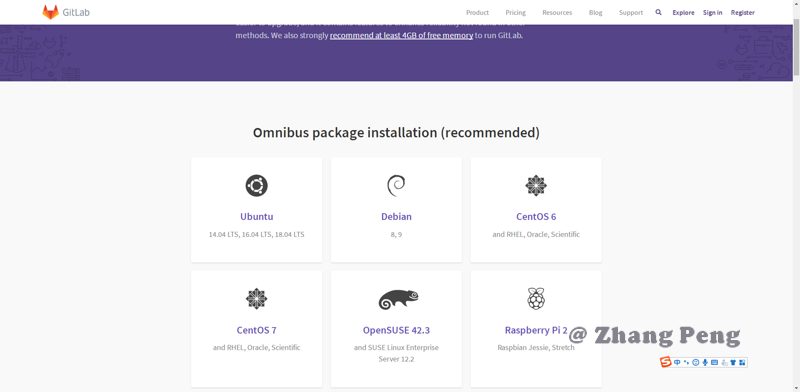
以 CentOS7 为例:
#### 安装和配置必要依赖
在系统防火墙中启用 HTTP 和 SSH
```
sudo yum install -y curl policycoreutils-python openssh-server
sudo systemctl enable sshd
sudo systemctl start sshd
sudo firewall-cmd --permanent --add-service=http
sudo systemctl reload firewalld
```
安装 Postfix ,使得 Gitlab 可以发送通知邮件
```
sudo yum install postfix
sudo systemctl enable postfix
sudo systemctl start postfix
```
#### 添加 Gitlab yum 仓库并安装包
添加 Gitlab yum 仓库
```
curl https://packages.gitlab.com/install/repositories/gitlab/gitlab-ce/script.rpm.sh | sudo bash
```
通过 yum 安装 gitlab-ce
```
sudo EXTERNAL_URL="http://gitlab.example.com" yum install -y gitlab-ce
```
安装完成后,即可通过默认的 root 账户进行登录。更多细节可以参考:[documentation for detailed instructions on installing and configuration](https://docs.gitlab.com/omnibus/README.html#installation-and-configuration-using-omnibus-package)
### Docker 安装 gitlab
拉取镜像
```
docker pull docker.io/gitlab/gitlab-ce
```
启动
```
docker run -d \
--hostname gitlab.zp.io \
--publish 8443:443 --publish 80:80 --publish 2222:22 \
--name gitlab \
--restart always \
--volume $GITLAB_HOME/config:/etc/gitlab \
--volume $GITLAB_HOME/logs:/var/log/gitlab \
--volume $GITLAB_HOME/data:/var/opt/gitlab \
gitlab/gitlab-ce
```
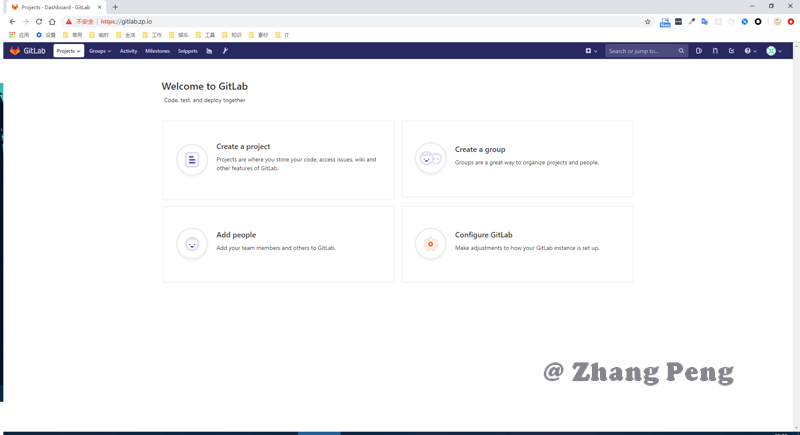
## 安装 gitlab-ci-multi-runner
> 参考:
### 常规安装 gitlab-ci-multi-runner
#### 下载
```
sudo wget -O /usr/local/bin/gitlab-runner https://gitlab-runner-downloads.s3.amazonaws.com/latest/binaries/gitlab-runner-linux-amd64
```
#### 配置执行权限
```
sudo chmod +x /usr/local/bin/gitlab-runner
```
#### 如果想使用 Docker,安装 Docker(可选的)
```
curl -sSL https://get.docker.com/ | sh
```
#### 创建 CI 用户
```
sudo useradd --comment 'GitLab Runner' --create-home gitlab-runner --shell /bin/bash
```
#### 安装并启动服务
```
sudo gitlab-runner install --user=gitlab-runner --working-directory=/home/gitlab-runner
sudo gitlab-runner start
```
#### 注册 Runner
(1)执行命令:
```
sudo gitlab-runner register
```
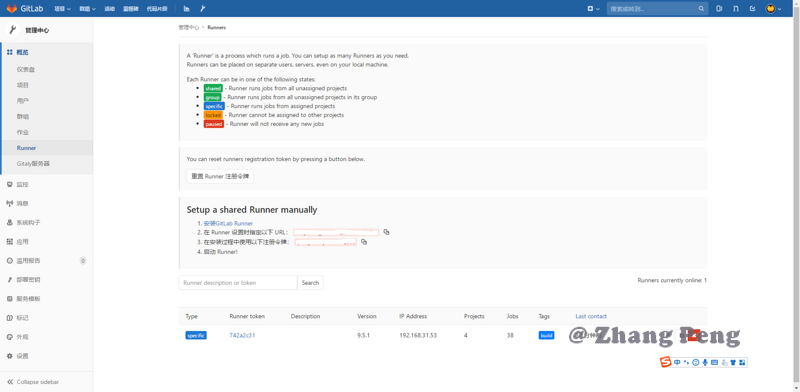
(2)输入 Gitlab URL 和 令牌
URL 和令牌信息在 Gitlab 的 Runner 管理页面获取:
```
Please enter the gitlab-ci coordinator URL (e.g. https://gitlab.com )
https://gitlab.com
Please enter the gitlab-ci token for this runner
xxx
```
(3)输入 Runner 的描述
```
Please enter the gitlab-ci description for this runner
[hostame] my-runner
```
(4)输入 Runner 相关的标签
```
Please enter the gitlab-ci tags for this runner (comma separated):
my-tag,another-tag
```
(5)输入 Runner 执行器
```
Please enter the executor: ssh, docker+machine, docker-ssh+machine, kubernetes, docker, parallels, virtualbox, docker-ssh, shell:
docker
```
如果想选择 Docker 作为执行器,你需要指定默认镜像( `.gitlab-ci.yml` 中没有此配置)
```
Please enter the Docker image (eg. ruby:2.1):
alpine:latest
```
### Docker 安装 gitlab-ci-multi-runner
拉取镜像
```
docker pull docker.io/gitlab/gitlab-runner
```
启动
```
docker run -d --name gitlab-runner --restart always \
-v /srv/gitlab-runner/config:/etc/gitlab-runner \
-v /var/run/docker.sock:/var/run/docker.sock \
gitlab/gitlab-runner:latest
```
## 自签名证书
首先,创建认证目录
```
sudo mkdir -p /etc/gitlab/ssl
sudo chmod 700 /etc/gitlab/ssl
```
### 创建证书
#### 创建 Private Key
```
sudo openssl genrsa -des3 -out /etc/gitlab/ssl/gitlab.domain.com.key 2048
```
会提示输入密码,请记住
#### 生成 Certificate Request
```
sudo openssl req -new -key /etc/gitlab/ssl/gitlab.domain.com.key -out /etc/gitlab/ssl/gitlab.domain.com.csr
```
根据提示,输入信息
```
Country Name (2 letter code) [XX]:CN
State or Province Name (full name) []:JS
Locality Name (eg, city) [Default City]:NJ
Organization Name (eg, company) [Default Company Ltd]:xxxxx
Organizational Unit Name (eg, section) []:
Common Name (eg, your name or your server's hostname) []:gitlab.xxxx.io
Email Address []:
Please enter the following 'extra' attributes
to be sent with your certificate request
A challenge password []:
An optional company name []:
```
#### 移除 Private Key 中的密码短语
```
sudo cp -v /etc/gitlab/ssl/gitlab.domain.com.{key,original}
sudo openssl rsa -in /etc/gitlab/ssl/gitlab.domain.com.original -out /etc/gitlab/ssl/gitlab.domain.com.key
sudo rm -v /etc/gitlab/ssl/gitlab.domain.com.original
```
#### 创建证书
```
sudo openssl x509 -req -days 1460 -in /etc/gitlab/ssl/gitlab.domain.com.csr -signkey /etc/gitlab/ssl/gitlab.domain.com.key -out /etc/gitlab/ssl/gitlab.domain.com.crt
```
#### 移除证书请求文件
```
sudo rm -v /etc/gitlab/ssl/gitlab.domain.com.csr
```
#### 设置文件权限
```
sudo chmod 600 /etc/gitlab/ssl/gitlab.domain.com.*
```
## gitlab 配置
```
sudo vim /etc/gitlab/gitlab.rb
external_url 'https://gitlab.domain.com'
```
#### gitlab 网站 https:
```
nginx['redirect_http_to_https'] = true
```
#### gitlab ci 网站 https:
```
ci_nginx['redirect_http_to_https'] = true
```
#### 复制证书到 gitlab 目录:
```
sudo cp /etc/gitlab/ssl/gitlab.domain.com.crt /etc/gitlab/trusted-certs/
```
#### gitlab 重新配置+更新:
```
sudo gitlab-ctl reconfigure
sudo gitlab-ctl restart
```
### 创建你的 SSH key
1. 使用 Gitlab 的第一步是生成你自己的 SSH 密钥对(Github 也类似)。
2. 登录 Gitlab
3. 打开 **Profile settings**.

1. 跳转到 **SSH keys** tab 页

1. 黏贴你的 SSH 公钥内容到 Key 文本框

1. 为了便于识别,你可以为其命名

1. 点击 **Add key** 将 SSH 公钥添加到 GitLab

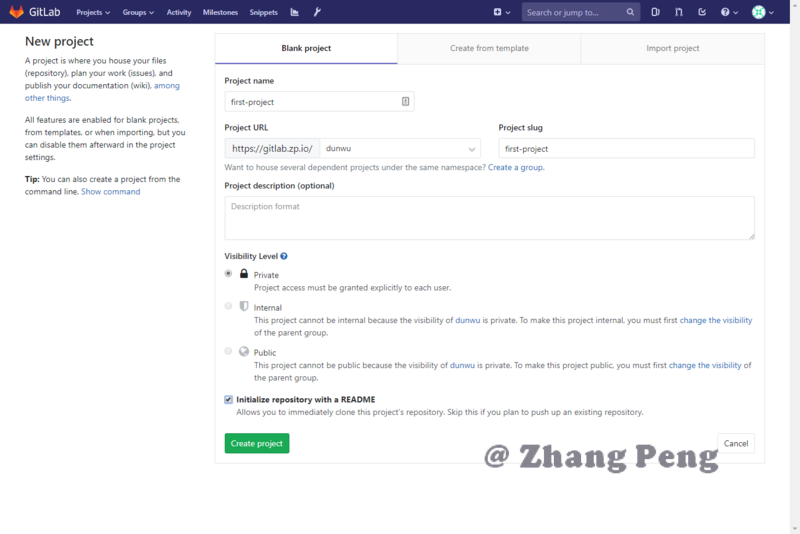
### 创建项目
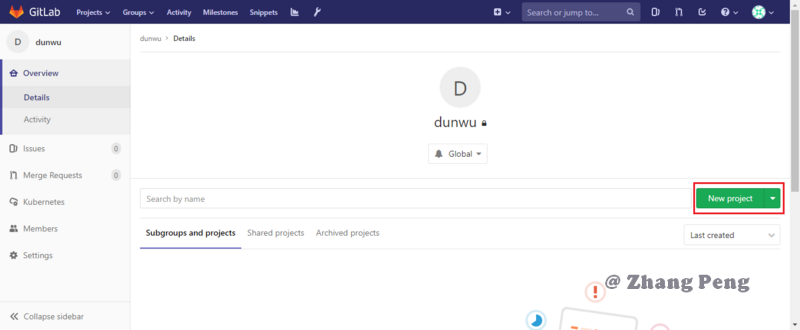
输入项目信息,点击 Create project 按钮,在 Gitlab 创建项目。
### 克隆项目到本地
可以选择 SSH 或 HTTPS 方式克隆项目到本地(推荐 SSH)
拷贝项目地址,然后在本地执行 `git clone `
### 创建 Issue
依次点击 **Project’s Dashboard** > **Issues** > **New Issue** 可以新建 Issue

在项目中直接添加 issue

在未关闭 issue 中,点击 **New Issue** 添加 issue

通过项目面板添加 issue

通过 issue 面板添加 issue

## 更多内容
* **引申**
* [操作系统、运维部署总结系列](https://github.com/dunwu/OS)